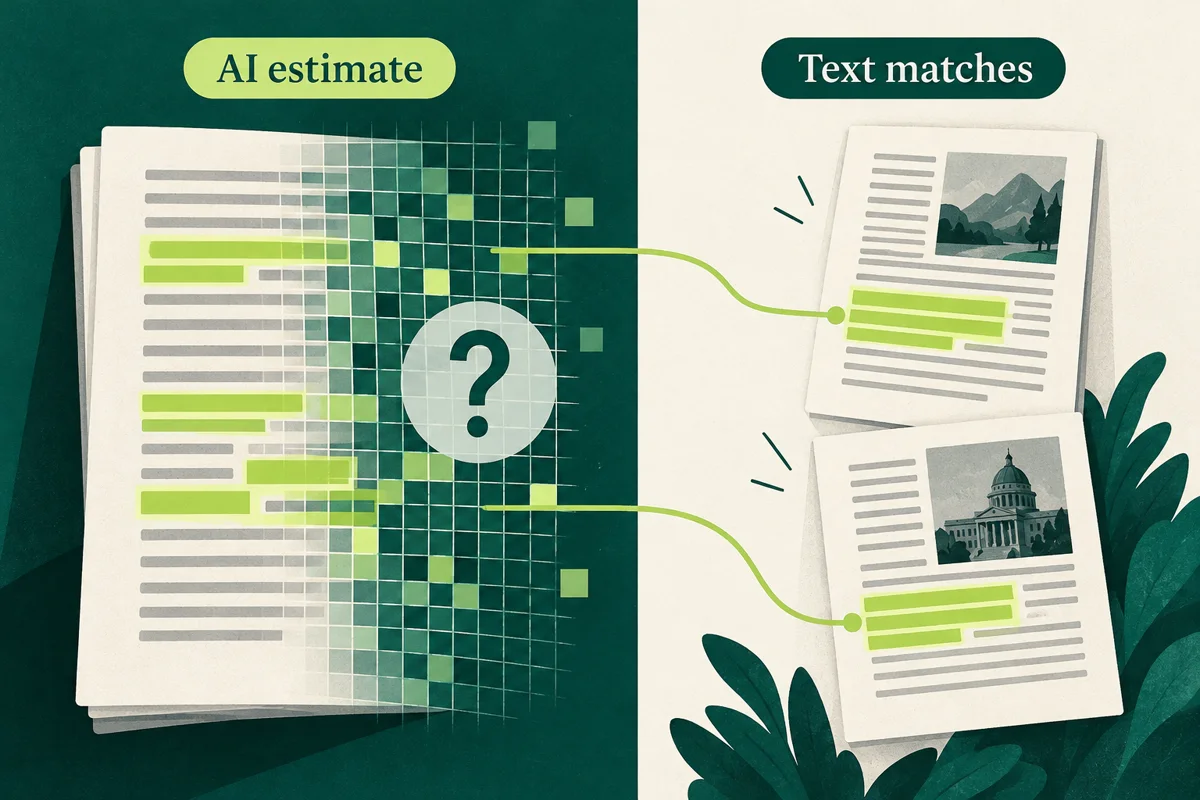
AI detector vs plagiarism checker: two different questions
An AI detector and a plagiarism checker do not measure the same thing. An AI detector estimates whether writing resembles text produced by an AI model; Turnitin says its report identifies qualifying prose that may be AI-generated, including AI-generated text subsequently modified with AI tools (Turnitin's AI Writing Report guide). A similarity checker finds passages that match sources in its database; Turnitin's student guide explains how the report highlights matching text (Turnitin's guide to the similarity score). A match is a reason to review a source and its citation; it is not automatically a finding of plagiarism.
Some products offer both reports. Read them separately and check what each percentage means before drawing a conclusion.
Start with the task rather than the size or colour of a number. To investigate matching wording, you need the matched passage and source. To interpret an AI-writing estimate, you need that model's definition and eligible text. To decide whether assistance or source use was permitted, you need the assignment's rules and the relevant evidence.
What an AI detector estimates
An AI detector analyzes patterns in the text and returns a model's estimate. The tool may show one score for the full passage and highlight sentences or sections for review. The score is not a record of who wrote the text, and tools use different models, labels and scales.
Turnitin says its AI-writing percentage is separate from its Similarity score. It also says its AI model may misidentify human-written, AI-generated or AI-paraphrased text, and that its result should not be the sole basis for adverse action (Turnitin AI Writing Report guide). Follow the institution's own review process and AI-use policy.
For Turnitin specifically, the AI percentage concerns qualifying long-form prose. It is not the same measurement as matching wording across the submission (Turnitin AI Writing Report guide). For a fuller explanation of eligible text and score interpretation, use our AI detection score guide.
What a similarity report compares
A similarity checker compares submitted text with material in selected databases. Turnitin's student guidance explains that matched text can include correctly cited quotations and references. The report shows where text matches; an instructor or writer must review the context and the source to decide whether the match is acceptable (Turnitin's guide to the similarity score).
This means a high similarity percentage is not, by itself, a plagiarism verdict. A low score does not prove that every source was cited correctly either. The useful part is the source list and the highlighted matches, not just the headline number (Turnitin's guide to the similarity score).
Turnitin's enhanced report groups matches by citation and quotation treatment, provides source cards and can show other sources that contain the same wording. Its available filters and exclusions are also part of the report context (Turnitin's enhanced Similarity Report overview). Those features support review; the presence of a highlight is not a completed judgment about the writer.
One draft. Two different questions.
- AI-writing detectionDoes the writing resemble AI text?
The result is a model estimate about patterns in the passage.
- Similarity checkingWhere does the wording match?
The report compares text against the sources available to that service.
Which report should you use?
Scroll the table to compare all columns.
| Your question | Useful evidence | Review focus |
|---|---|---|
| AI-writing patterns? | AI detector estimate | Definition and eligible text |
| Matching wording? | Similarity report | Passage, source and citation |
| Rule or policy question? | Policy and human review | Context and working records |
Before using a report, check what it scans, which sources it compares against, whether the text length qualifies, and how the result is meant to be interpreted. If a report will affect an important decision, use the proper institutional process rather than relying on one percentage.
Read a similarity match in context
Use this original review sequence with the report your institution actually provides. Interface labels vary, so the aim is to record evidence rather than follow a fixed set of buttons.
- Identify the exact document version and report date. Do not compare a report for one draft with a different revision without noting the change.
- Select a matched passage and read the surrounding paragraph. Identify whether it is a quotation, source-based explanation, reference entry or the writer's own analysis.
- Open the matched source where access permits. Check the wording and source location yourself; keep unresolved or inaccessible matches as questions for the instructor.
- Review quotation marks, attribution and the reference entry together. A reference at the end does not explain which words in the paragraph are a direct quotation.
- Record the source, any citation repair and any unresolved question. Then read the paragraph again to confirm it still supports the argument.
Purdue OWL distinguishes exact quotation from paraphrase and summary, and says all three ways of using another writer's material require attribution (Purdue OWL: quoting, paraphrasing and summarizing). Use our source-use methods guide when deciding how to integrate a source; this page focuses on reading the reports.
The situations below are manual review prompts, not simulated report outputs or predictions about whether software will highlight text. No score, student case or tool test is represented.
Scroll the table to compare all columns.
| What you are reviewing | Check | Next step |
|---|---|---|
| An exact quotation | Wording and source location | Check quote and citation. |
| Source wording in prose | Quotation and attribution | Repair missing treatment. |
| A borrowed idea | Where the idea came from | Credit the source. |
For example, noticing that a definition is correctly quoted and attributed answers a source-use question about that passage. It does not identify who wrote the rest of the document or settle an AI-use policy question. Conversely, wording a source's idea differently does not remove the need to acknowledge that source. Review the evidence relevant to each question.
When the two results seem to disagree
An AI-writing estimate and a list of source matches are not two votes on the same fact. Turnitin explicitly describes its AI result as independent of its Similarity score (Turnitin AI Writing Report guide). Inference: adding, subtracting or averaging these percentages would not produce a meaningful combined authorship score.
If your concern is a missing citation, resolve the source-use issue even when an AI estimate does not raise a concern. If your concern is permitted AI assistance, consult the actual course policy and working record rather than treating a lack of source matches as permission. Neither question is resolved by replacing a passage solely to change a number.
There is no universal acceptable Similarity score: Turnitin directs students to their assignment and institution's expectations (Turnitin's student similarity guidance). Ask what the instructor expects instead of adopting a cutoff from an unrelated website or another class.
Keep a report-reading record
Copy this worksheet for your own review. Fill it with what you can actually observe and label missing information as unknown. It is an original editorial aid, not a required institutional form or evidence that any particular result is accurate.
Scroll the table to compare all columns.
| Record | What to write down |
|---|---|
| Document and report | Draft version; date; report type |
| Tool and context | Product; interface; settings |
| Measured material | Eligible text or selected sources |
| Passage under review | Location in your draft |
| Source evidence | Matched source and relevant place |
| Action taken | Citation repair or explanation |
| Unresolved question | What still needs clarification |
For a similarity report, note any filters or exclusions already applied; for an AI report, note what its score covers. Record differences before comparing reports. Do not change settings merely to obtain a smaller headline value. Keep the underlying quotation and citation checks even when a report excludes that material from its displayed total.
If a source location or match is inaccessible, say so rather than inventing an explanation. You can ask an instructor: Which report and passage are we reviewing? Which document version and settings were used? What source or policy concern needs clarification? Bring relevant drafts, source notes and your explanation of the work. Our version-history guide helps organise those records; it does not certify authorship.
Where HumanWords fits
HumanWords provides an AI-writing estimate and a separate rewrite that you can compare with your original. It does not provide a source-matching plagiarism report. If your task is to locate passages that match published sources, use a similarity checker that describes its source database and report process. If you use HumanWords to revise wording, review the revision for meaning, evidence, quotations and citations using the revision checklist.
Before uploading a draft to any service, check permission and data handling using our essay-upload privacy checklist. You can complete the report-reading worksheet without purchasing HumanWords or submitting your writing to another tool. Follow the rules that apply to your assignment or workplace.