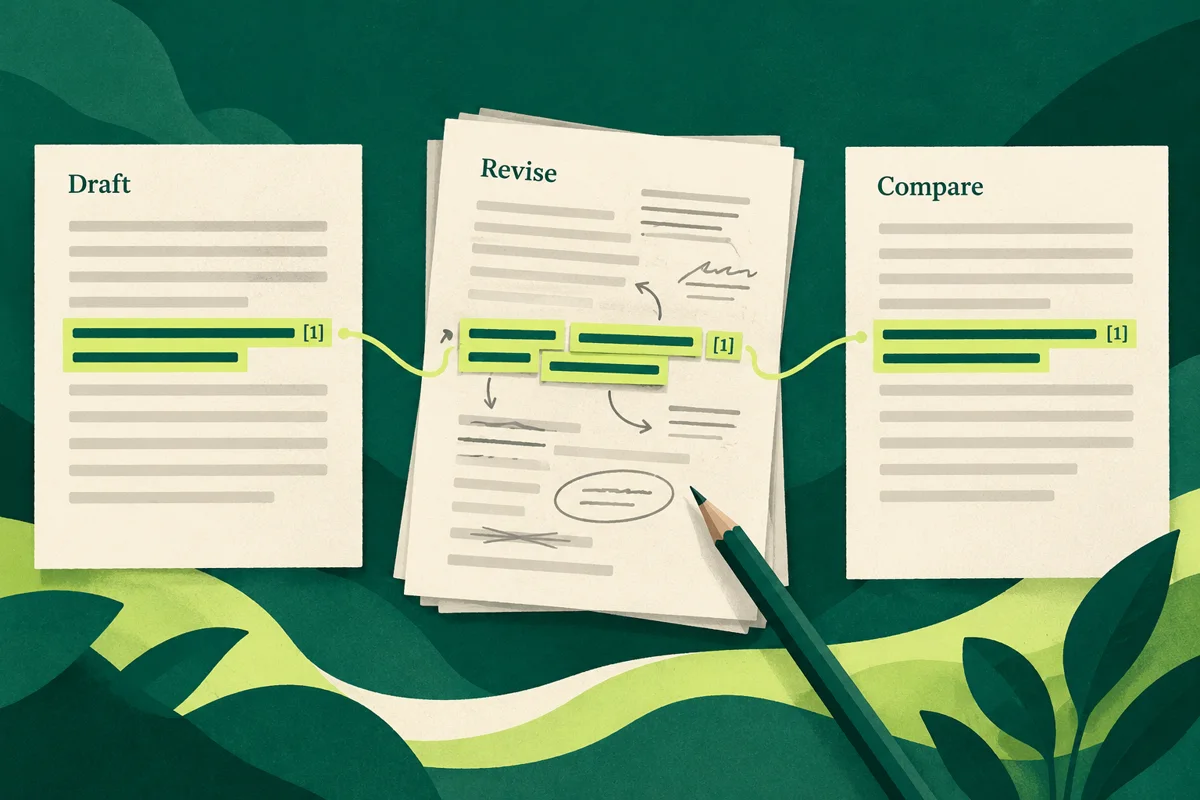
Start with the paragraph’s main claim
Before revising an AI-assisted draft, write one sentence that states what the paragraph claims and what evidence supports it. If you cannot state the claim clearly, improve the argument before polishing its wording.
The aim is to improve the expression while preserving what the paragraph actually says. A shorter or more confident sentence can still be the wrong revision if it removes a condition, changes the population or adds a promise. Use the worked example below to compare meaning before deciding which wording to keep.
List the details that must stay exact: names, dates, amounts, technical terms, and who did what. Keep this short checklist beside the draft while you edit. If the original contains an error, correct it against its source and record the correction; preserving meaning does not mean preserving a known mistake.
If you are introducing someone else's source passage rather than polishing your own draft, first choose between quoting, paraphrasing and summarizing. Each serves a different purpose in your paragraph.
Protect facts and qualifiers
Compare one paragraph at a time. Check whether the rewrite changes certainty or scope: “may” to “will,” “some” to “all,” or “is associated with” to “causes.” A small word change can make a much stronger claim. Purdue OWL advises comparing a paraphrase with its original to check that essential information survives (Purdue OWL guide to paraphrasing).
For example, “the survey suggests commuting time may affect concentration” does not mean the same thing as “commuting time causes poor concentration.” The second sentence asserts causation that the first sentence does not establish.
Use these anchors to make the comparison concrete. This is an editorial checklist, not a measured guarantee that a tool preserves meaning.
Scroll the table to compare all columns.
| Anchor | Check | Watch for |
|---|---|---|
| Actor and action | Same actor and task? | Peers become graders. |
| Scope and quantity | Same group and limits? | Up to 20 becomes everyone. |
| Time and sequence | Same dates and duration? | A trial becomes ongoing. |
| Certainty and conditions | Conditions still present? | Would becomes will. |
| Evidence and attribution | Source supports the claim? | Suggestion becomes proof. |
When a sentence relies on research, reopen the source and check its support for the revised claim. A citation beside a sentence does not repair wording that goes beyond the evidence. Keep quotations exact and use the citation-preservation checklist for references and quoted passages.
Keep the argument through every edit.
- 1 · StartState the claim
Write down what the paragraph is actually saying.
- 2 · CompareCheck qualifiers
Watch for changes such as “may” becoming “will”.
- 3 · VerifyProtect evidence
Check facts, quotations and citations against the original.
- 4 · FinishReview the revision
Keep the version that expresses your intended meaning.
Worked example: fluent wording, changed meaning
The following workshop proposal is invented for practice. Both rewrites were written manually for this article. No university announced this programme, and no HumanWords or competitor output was tested.
Original proposal
From September, the writing centre proposes a four-week Saturday workshop for up to 20 first-year students. Sessions would run from 10 a.m. to noon if enough tutors are available. Participants could bring one draft for peer feedback; the pilot would not include grading or a guarantee of a higher mark. After the trial, the centre would review attendance and comments before deciding whether to repeat it.
Fluent but inaccurate rewrite
Starting in September, the writing centre will offer an ongoing Saturday programme for all undergraduates. Sessions run from 9 a.m. to noon, with expert tutors grading each student's work and ensuring higher marks. Students can submit their drafts for professional feedback, and the successful programme will continue every term.
The second version reads smoothly, but it announces a different programme. Compare the commitments, not just whether the sentences sound good.
Scroll the table to compare all columns.
| Original anchor | Inaccurate rewrite | Meaning changed |
|---|---|---|
| Four-week proposal | Ongoing commitment | Trial becomes permanent. |
| Up to 20 first-year students | All undergraduates | Group and capacity change. |
| 10 a.m.–noon, if staffed | 9 a.m.–noon | New time; condition lost. |
| One draft; peer feedback | Drafts; expert feedback | Quantity and role change. |
| No grading or mark promise | Grading; higher marks | An exclusion is reversed. |
| Review before deciding | Continue every term | Decision becomes promise. |
Reviewed revision
The writing centre is proposing a four-week Saturday workshop from September for a maximum of 20 first-year students. If enough tutors are available, sessions would take place between 10 a.m. and noon. Participants could bring one draft for feedback from their peers. The pilot would offer neither grading nor a guarantee of higher marks. The centre would review attendance and comments after the trial, then decide whether to run it again.
This revision changes sentence structure and separates the feedback and grading details while retaining the original proposal's limits. It is one possible version, not a claim that every word must stay the same. For a shorter summary, you could omit detail when the task allows, but you should not replace an omitted condition with an unconditional promise.
Review the revised passage
Compare the original and revision side by side. Read a complete paragraph first, then check its factual anchors. A detail can remain somewhere in the rewrite yet attach to the wrong person, event or time.
- State the paragraph's claim in your own words before editing.
- Mark names, numbers, dates, negations, technical terms and conditions in the original.
- Locate each anchor in the revision and check what it refers to.
- Reopen supporting sources for factual claims and quotations. Mark anything you cannot verify as unresolved.
- Correct changed meaning, then read the complete paragraph again for connections and emphasis.
- Keep the original and record deliberate corrections before accepting the revision.
For your own draft, copy this small review sheet and fill it in. One row per disputed detail is more useful than a general note that the rewrite looks fine.
Scroll the table to compare all columns.
| Detail | Check against original/source | Record your decision |
|---|---|---|
| May, would or will | Established or conditional? | Keep, correct or verify. |
| Number, group or date | Exact value and scope? | Value and source location. |
| Quotation or attribution | Exact words; whose claim? | Wording or attribution fix. |
| Example or experience | Supplied by writer and true? | Remove or verify additions. |
Do not use a detector score as this review sheet. A score does not identify which workshop time is correct or whether a source supports a causal claim. Read what an AI detection score can and cannot tell you if you need to interpret a separate detection result.
Read the complete paragraph after editing. Confirm that the evidence still supports the claim, the sentences connect, and the revision has not inserted a fact, example, or personal experience that you did not provide. HumanWords does not check a rewrite against your sources, so verify those details yourself.
If you use HumanWords to revise a passage, treat the result as a candidate to review with the original and sources beside it. Keep only wording you understand and can explain. The comparison above also works for manual editing; no purchase or rewriting tool is needed.
For a whole-essay structure check before polishing sentences, make a reverse outline to map each paragraph's point and function, then plan changes to order or emphasis.
Keep a clear writing record
Save the original draft, the reviewed version and short notes explaining factual corrections. Keep source locations with those notes so another review does not depend on memory. The draft and version-history guide explains how to organise that record.
For coursework, check the assignment's AI rules before using a rewriting tool and follow its disclosure requirements. Maricopa Community Colleges advises checking the course and assignment policy, asking when uncertain, explaining allowed AI use and retaining drafts and notes (Maricopa student guidance). Texas A&M's Writing Center likewise recommends understanding each instructor's policy and keeping evidence of the writing process (Texas A&M writing-center guidance). These are examples of institutional guidance, not permission for every course or a guarantee about a misconduct decision.