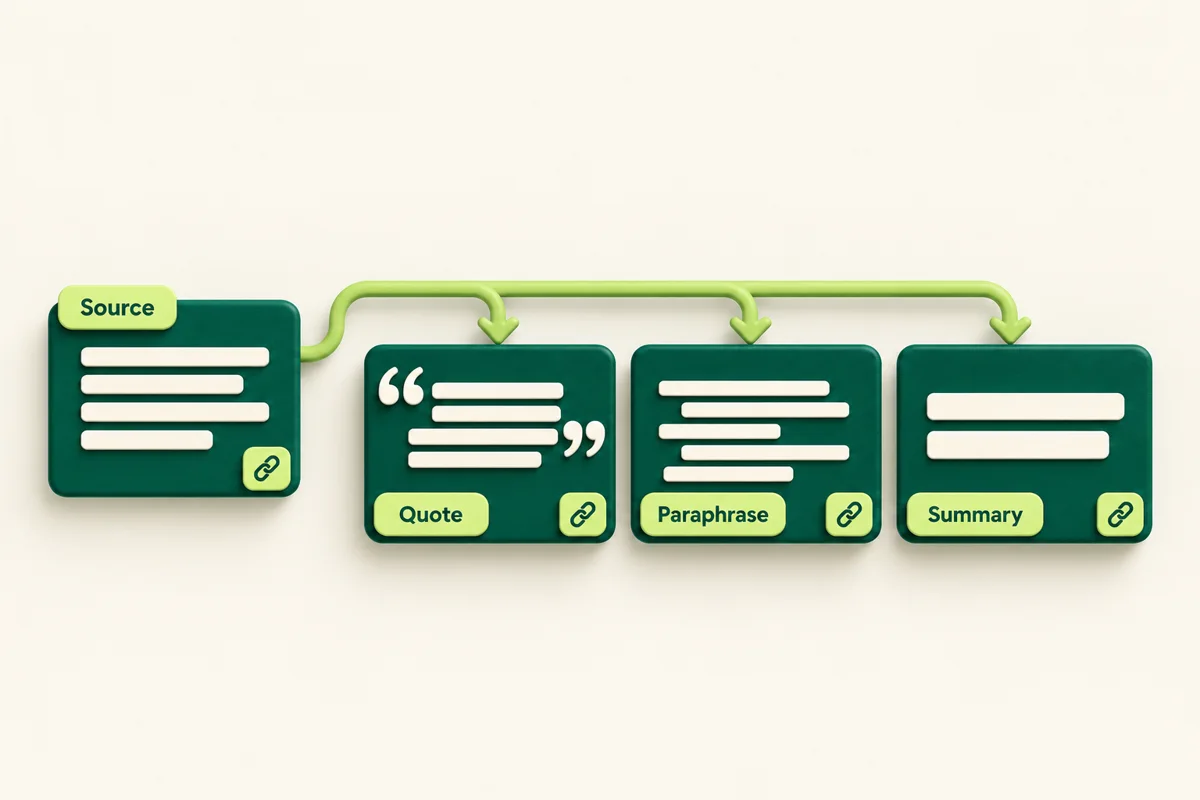
Choose what your reader needs from the source
Quote when the exact wording matters. Paraphrase when a particular idea and its detail matter. Summarize when the reader needs the main point. In all three cases, make the source clear. Purdue OWL distinguishes these approaches by how closely the writing follows the source and says borrowed wording or ideas need attribution (Purdue OWL: quoting, paraphrasing and summarizing).
The choice starts with the job the source does in your paragraph. Are you analysing a phrase, explaining a specific argument, or giving a short overview before your own analysis? Choose for that purpose, not simply to make text look different.
Three ways to use a source, one need for attribution
- Exact wordingQuote
Retain the chosen words and explain why that wording matters.
- Relevant detailParaphrase
Express the particular idea in your own language and structure.
- Main pointsSummarize
Give the overview the reader needs without unnecessary detail.
The differences at a glance
Scroll the table to compare all columns.
| Approach | What you keep | What changes | A useful reason to choose it |
|---|---|---|---|
| Quotation | The selected source wording exactly | How you introduce and discuss that wording | The wording itself is part of your analysis |
| Paraphrase | The meaning and relevant detail of a particular passage | The expression and sentence structure | Your reader needs the idea explained within your argument |
| Summary | The central point or points | The level of detail and length | Your reader needs a brief overview rather than the full passage |
Toronto's writing guidance describes paraphrase as restating ideas at roughly the same detail level, and summary as reducing the work to its essential points. Purdue notes that paraphrases may condense a passage too. The distinction is therefore not just a word-count test: ask how much of the source's detail your reader needs (University of Toronto: paraphrase and summary; Purdue OWL: the three approaches).
One practice passage, three different uses
The following notice is invented by HumanWords for this exercise. It is not a real library announcement, research finding or quotation from one of the university sources. The examples let you compare the three approaches without a fabricated author, date or study citation.
Practice notice: From next month, the library will open one hour earlier on weekdays. Weekend hours will stay the same. The change is a three-month trial, after which staff will review attendance before deciding whether to continue.
Quotation: discuss the exact wording
Example: The practice notice says, “Weekend hours will stay the same.” That sentence limits the change to the weekday schedule.
The quoted words match the practice passage. The next sentence explains why that wording matters to the point being made. It is not enough to drop a quotation into a paragraph and expect it to explain itself.
For a real source, retain its exact quoted wording, clearly mark it as a quotation, and cite it in the required style. Purdue's guidance says quotations must match their source and be attributed. Follow your style guide for short or block quotations rather than copying this exercise's informal attribution (Purdue OWL: quotation requirements).
Paraphrase: keep the relevant detail
Example: According to the practice notice, the library will test an earlier weekday start for three months beginning next month, while retaining its weekend schedule. Staff will then consider attendance when deciding whether the earlier opening should continue.
This version retains the timing, the weekday/weekend distinction, the trial period and the later decision. It expresses those details with a different structure. It does not turn a temporary change into a permanent promise.
The phrase “According to the practice notice” identifies the origin for this teaching example. For someone else's actual work, supply the required citation as well. New wording does not make the underlying idea yours; Toronto explicitly requires a reference when paraphrasing (University of Toronto: paraphrasing).
Summary: give the main point
Example: The practice notice announces a trial of earlier weekday library opening, with continuation to be decided later.
This keeps the main development and its temporary status while omitting the exact opening difference, start date, trial duration and review measure. That may fit a broad overview. It would not be enough if your argument specifically depended on the three-month duration.
A summary's omissions should serve the purpose of your paragraph without distorting the source. Keep attribution: Purdue says summarized ideas must still be credited (Purdue OWL: summary and attribution).
What a too-close rewrite misses
Consider this deliberately weak rewrite of the exercise:
Too close: Starting next month, the library will open sixty minutes earlier on weekdays. Weekend hours will remain unchanged. The change is a three-month experiment, after which staff will examine attendance before deciding whether to continue.
Most of the original sentence pattern remains, with substitutions such as “sixty minutes” for “one hour.” The problem is the method: changing isolated words while following the source line by line. This is our original illustrative example, not a report of student misconduct or a tool's output.
UW–Madison's Writing Center shows why both word-for-word copying and patchwork paraphrases can be problematic. Its examples explain that acknowledging the source does not excuse copied language that has not been marked as quotation (UW–Madison: quoting and paraphrasing).
Return to the idea rather than searching for more synonyms. If the expression matters, quote it properly. If it does not, explain the relevant meaning from your understanding and then compare it with the source for accuracy.
A practical method for working from notes
Toronto recommends noting the source's basic points in your own language, keeping its reference details, drafting from those notes, and returning to the original to check both accuracy and expression (University of Toronto: writing from notes). Our worksheet makes those separate checks visible:
Scroll the table to compare all columns.
| Note | Question to answer before drafting |
|---|---|
| Source and location | Where can you find the relevant passage again? |
| Meaning | What is the author actually saying in this part? |
| Purpose | Why does your reader need this material here? |
| Approach | Do you need the wording, the detail or the overview? |
| Accuracy check | Did you preserve scope, timing, uncertainty and attribution? |
| Your contribution | What will you explain, analyse or argue after introducing the source? |
For the practice notice, a compact meaning note might be: earlier weekdays; weekends unchanged; temporary trial; review before continuation. That is a note about the exercise, not a substitute for reading an unfamiliar source carefully. When writing your paragraph, select the points it needs, then check the resulting statement against the original.
Keep citation and your own analysis attached
Do not treat source use as a choice between “my words” and “needs a citation.” A paraphrase or summary can use your words while still representing another person's ideas. Purdue and Toronto both require attribution for that use. Use the citation and source-location details your assignment's style requires; there is no invented author-date reference to copy from the practice exercise.
After introducing the source, explain its relevance. For example, a paragraph about temporary service changes might focus on the trial and later review. A paragraph about access outside office hours might need the unchanged weekend schedule. Neither task is solved merely by rewriting the notice.
Our citation-verification guide covers the next task: checking a reference and whether it supports a claim. Our revision guide focuses on preserving an existing draft's meaning.
If you use a writing tool
Check your course's rules before using AI assistance. Then review any permitted output against the actual source, retain attribution and keep exact source wording clearly marked as quotation. A changed phrasing or a detector score does not perform those checks for you.
If your course permits it and you choose HumanWords for revision, compare its output with both your draft and the source. It is not a replacement for source verification or your own explanation. See our AI-use disclosure examples if acknowledgement is required.
Final check before you submit
- Did you choose quotation, paraphrase or summary for a clear reason?
- Are quoted words exact and marked according to the required style?
- Does a paraphrase use your own expression rather than a sequence of substitutions?
- Does a summary keep the main point without a misleading omission?
- Are borrowed ideas and wording attributed to the right source?
- Can the reader distinguish the source's contribution from your analysis?
- Have you checked any permitted tool output against the source yourself?
Sources and scope
- Purdue OWL: Quoting, Paraphrasing, and Summarizing. Definitions, differences and attribution requirements; checked 29 October 2026.
- University of Toronto: Paraphrase and Summary. Detail versus overview, own expression, reference requirements and working from notes; checked 29 October 2026.
- UW–Madison Writing Center: Quoting and Paraphrasing. Examples illustrating word-for-word and patchwork source use; checked 29 October 2026. Its examples were not reproduced here.
The library notice, four worked examples, worksheet and checklist are original HumanWords teaching material. They describe no real library decision, student case, detector test or product-quality experiment. Informal attribution in this exercise demonstrates source boundaries; it is not an APA, MLA or Chicago citation template. Exact search volume is unknown.