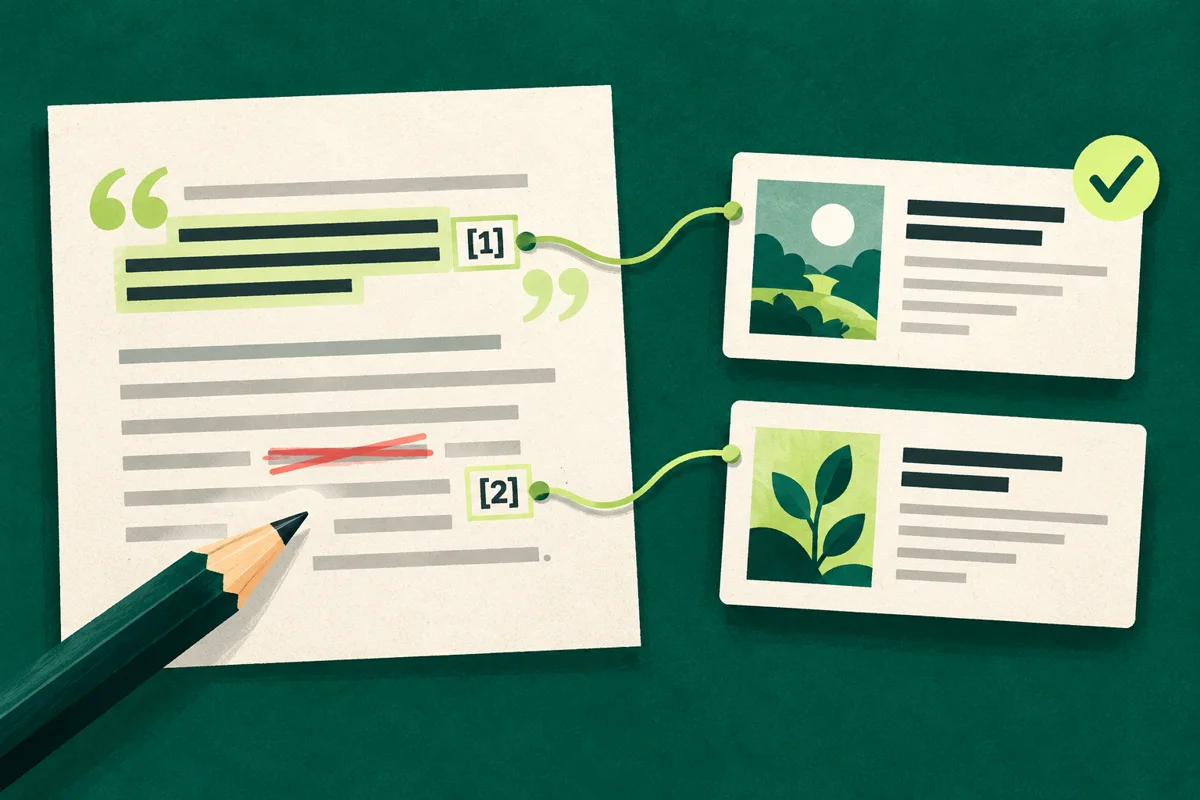
Verify the reference before polishing the prose
Treat an AI-suggested reference as a lead to investigate. First locate the source, match its details, and read the part that supports your claim. Then revise the sentence while keeping that evidence attached. MLA's guidance says to follow AI-provided references to the source text, read it, and cite it directly rather than relying on the AI output (MLA: describing AI use).
There are three separate checks: does this source exist, is it the right source, and does it support this particular statement? Finding a real paper answers only the first question. This guide walks through all three, then shows what to preserve during a rewrite.
From a proposed reference to a supported sentence
- 1 · FindLocate the work
Use the title, author or identifier to find the actual source.
- 2 · MatchCheck its details
Compare the reference with the source record and version.
- 3 · ReadVerify the claim
Find the passage that supports the statement you want to make.
- 4 · PreserveCompare the rewrite
Keep the quotation, meaning and attribution attached.
Check whether the source exists
Start with the exact article or book title. Compare a result with the author, year and publication named in the proposed reference. If you have a DOI, follow it and check the destination rather than trusting the appearance of the identifier.
Crossref's public metadata search can help identify registered scholarly works. Its documentation explains that the records come from members and trusted sources and can be searched through its API. A metadata match is a discovery aid; you still need to inspect the work (Crossref: retrieving metadata).
For biomedical references, PubMed's citation-search help says you can search an article title or details such as author, journal and year. It also explains that its matching can tolerate an incorrect term, which is another reason to inspect the returned record carefully (PubMed: find a specific citation). Use a database appropriate to the subject you are researching.
If an initial search finds nothing, change the search: try a shorter distinctive title phrase, the author and year, or your library's catalogue. A missing search result does not by itself establish that a source was invented. Record the reference as unverified until you can identify it; ask a librarian or choose a source you can verify rather than guessing its details.
Match the record to the proposed reference
Check more than whether a link opens. Our practical comparison sheet is:
Scroll the table to compare all columns.
| Detail | What to compare | What needs another look |
|---|---|---|
| Title | The proposed title and the publisher or catalogue record | A similar topic with a different title |
| Author | Names and order in the actual record | A plausible name attached to someone else's work |
| Date and version | The source version you read and the date used in the citation | A preprint, later edition or online date being silently substituted |
| Publication | Journal, proceedings, publisher or repository | A journal name that does not match the destination |
| Identifier and location | DOI, stable URL, and the relevant page or section | A working identifier that belongs to a different work |
Do not repair an uncertain reference by filling in details from memory. Keep a note of the record you checked and follow the citation style required for your assignment. For sources without a DOI, use the appropriate publisher, catalogue or subject-database record instead.
Check the claim in the source itself
Open the actual source and locate the passage, table or result you want to use. Record where it appears and read the surrounding explanation. Ask whether the proposed sentence keeps the source's scope: the population studied, conditions tested, uncertainty and limitations.
MLA warns that AI output can omit context and contain errors. That is why checking the original text matters even after you have found a genuine reference (MLA: source verification). A title, abstract or search snippet may help you locate relevant material; use the actual source passage for the detailed claim you plan to make. If you cannot inspect enough of the source to support the statement, keep that limitation visible or use evidence you can access.
Avoid strengthening a claim during revision. For example, turning “was associated with” into “caused” changes the assertion. That is an editorial example, not a quotation from a study. Check the revised wording against the source rather than assuming that fluent language is faithful language.
Worked check using a real public paper
Consider the publicly available paper RAID: A Shared Benchmark for Robust Evaluation of Machine-Generated Text Detectors. For this example, we checked its publisher record, its Crossref metadata and its DOI destination on 26 October 2026 (ACL Anthology record; Crossref record).
Scroll the table to compare all columns.
| Check | What the public records show |
|---|---|
| First author | Liam Dugan |
| Publication year | 2024 |
| Venue | ACL 2024, long papers |
| DOI | 10.18653/v1/2024.acl-long.674 |
| DOI destination checked | The matching ACL Anthology paper page |
Those matching fields identify a real work. They do not validate every sentence someone might attach to it. The paper's abstract describes evaluating text detectors under varied conditions; it does not establish the accuracy of an untested HumanWords scan. Open the paper and locate the evidence needed for your particular statement (paper and abstract).
Here is an original wording example based on that broad topic, not a quotation from the paper:
Before: The study evaluates detectors under varied conditions (Dugan et al., 2024).
After: The detector evaluation covers several testing conditions (Dugan et al., 2024).
The citation remains attached to the same limited assertion. A more detailed statement would require a more detailed source check. This example demonstrates a verification process, not a test of an AI detector or a complete reference formatted for your course.
Preserve quotations and citations while rewriting
Keep a direct quotation separate from your explanation. Compare its words with the original source before and after revising the surrounding text. Purdue OWL distinguishes quotations that match the source's wording from paraphrases and summaries that use your wording but still require attribution (Purdue OWL: quotations, paraphrases and summaries).
For your own paraphrase, keep the source's meaning and limitations, not merely a few replaced words. Leave the citation close enough that the reader can tell which claim it supports. If a revision splits one sentence into several or combines claims from different sources, check the attribution again.
Review the reference list separately: every in-text citation should connect to the intended entry, and each entry should describe the source version you actually consulted. For general revision checks, use our meaning-preservation guide. If you need to identify an AI conversation itself, the APA, MLA and Chicago guide covers that different citation task.
Keep a small verification record
Before rewriting, save your original draft and a compact record of the sources you checked. Our suggested log is:
Scroll the table to compare all columns.
| Source identifier | Claim or quotation supported | Location checked | Decision |
|---|---|---|---|
| [Actual DOI, stable URL or catalogue record] | [The specific point you want to use] | [Page, section, paragraph or table] | [Retain, correct, qualify or remove] |
Use real details from your research. Do not copy this placeholder row into a bibliography. A record of the claim and its location makes a later comparison more useful than a list of links alone.
Common questions
Does a working DOI mean the citation is correct?
It means you have a destination to inspect. Compare the work's title, author and publication details, then read the material supporting your statement. A working link to the wrong paper does not support your claim. The worked example above separates identification from evidence checking.
What if a source is paywalled or a link has moved?
Look for the publication through your library or a legitimate version provided by the publisher or author. PubMed's help describes links to publisher sites, freely available full text and library access where applicable (PubMed: getting the full text). Lack of access alone does not establish that a reference is false; it limits what you can verify from it.
Does HumanWords automatically verify my bibliography?
HumanWords keeps your original beside the returned revision for comparison. You still need to identify sources and check author names, dates, quotations, figures and whether the evidence supports each assertion. Do not treat a rewrite or detector score as a completed reference audit. Follow your course's requirements for AI use and disclosure.
Make a final comparison
- Each source can be identified in an appropriate publisher, catalogue or database record.
- The reference details match the work and version you read.
- Every important assertion has support in the actual source, with its limits retained.
- Quoted wording still matches the original and has the required attribution.
- Citations remain attached to the claims they support after sentences move or change.
- In-text citations and reference entries still correspond.
- Unverified references have been resolved, replaced with verified evidence or removed.
The aim is a draft whose evidence you can explain. Clearer wording is useful when the source support survives the edit too.
Sources checked 26 October 2026
- MLA Style Center: Beyond Citation—Describing AI Use — checking original sources behind AI output.
- Crossref: REST API documentation — what its searchable metadata records contain.
- PubMed User Guide — finding a specific citation; the same guide covers access to full text.
- PubMed: getting full text — source-access options in the FAQ.
- Purdue OWL: Quoting, Paraphrasing, and Summarizing — the distinction between quotation and paraphrase.
- ACL Anthology: RAID paper — the real public worked example.
- Crossref metadata for the RAID paper — author, title, year and DOI checked against the publisher record.