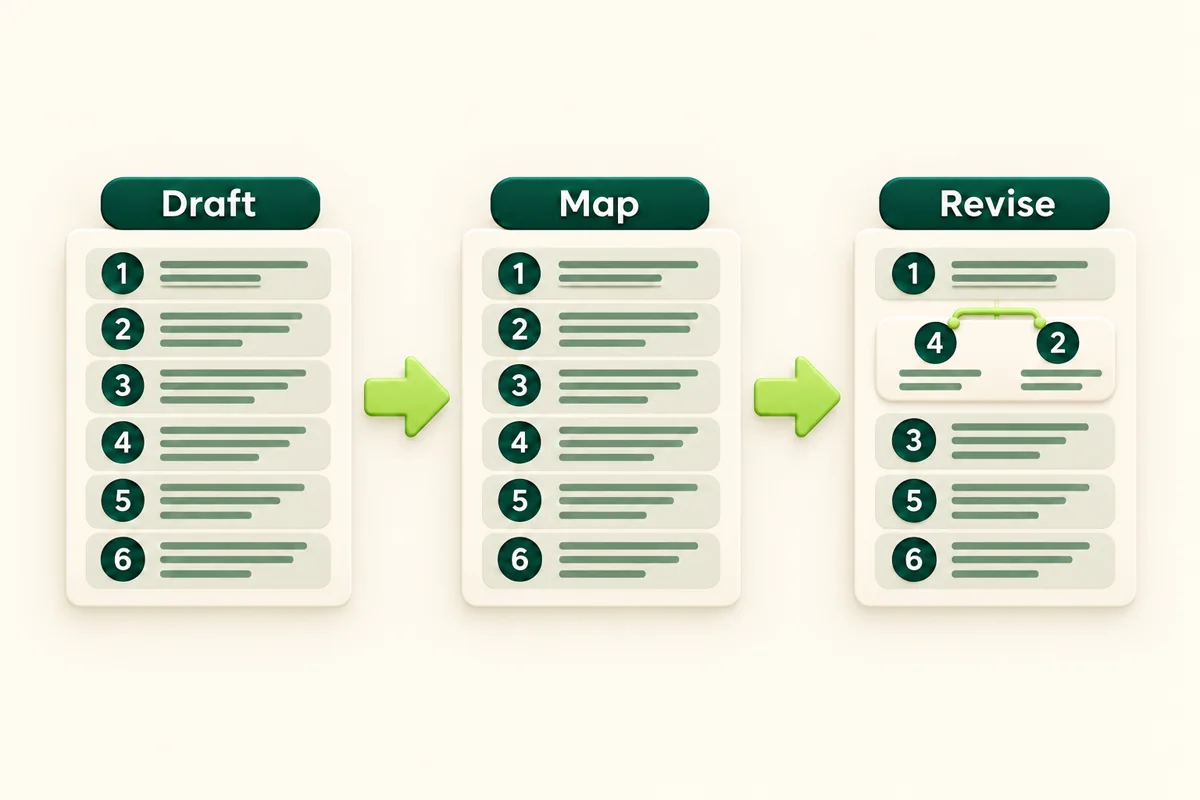
Map the essay you wrote, not the one you planned
A reverse outline is a short map made after you have writing to examine. Record each paragraph's main point and what it does in the argument, then read those notes in order. You are checking the structure on the page rather than relying on the outline you intended to follow.
UW–Madison's Writing Center describes reverse outlining as reducing a draft to its main ideas so the writer can examine organisation and make paragraph-level decisions. Its guidance allows either a full or partial draft (UW–Madison: creating a reverse outline).
This is a structure check, not another name for proofreading. Waterloo distinguishes revision of argument, logic, evidence and organisation from the later proofreading stage (Waterloo: revision). A sentence can be clear while its paragraph still arrives in the wrong place.
From existing paragraphs to a revision plan
- 1 · ReadInspect the actual draft
Use the paragraphs on the page rather than the intended outline.
- 2 · MapNote point and function
Describe what each paragraph says and does for the reader.
- 3 · DiagnoseCheck gaps and order
Distinguish repetition from missing evidence or analysis.
- 4 · PlanChoose specific actions
Keep, move, merge, split or develop material for a stated reason.
Build a paragraph map before editing sentences
Start with a saved copy of the draft. Number its paragraphs and write a brief note beside each one. Our practical worksheet uses four fields:
Scroll the table to compare all columns.
| Field | Question to answer | A useful note looks like… |
|---|---|---|
| Main point | What does this paragraph actually say? | A specific claim, not just a topic label |
| Function | What does it do for the reader? | Defines a term, supports a claim, answers an objection or explains a proposal |
| Support | What evidence or reasoning is present? | The source, example or explanation actually used; identify a gap honestly |
| Next action | What needs attention after you map the whole draft? | Keep, move, merge, split, develop or reconsider |
Do not automatically copy the first sentence. If it does not represent the paragraph, write a summary of what the paragraph really does. UW–Madison describes both topic-sentence and summary-based approaches, including recording a paragraph's subject and function (UW–Madison: mapping the draft).
Keep the first pass descriptive. “This paragraph should prove my proposal is fair” is an intention. “This paragraph states a concern about access but does not answer it” is a diagnosis you can act on.
A short draft to practise on
The following is original, invented HumanWords practice material. It describes an imaginary campus proposal, not a real policy, survey or research finding. Its claims would need appropriate support in an actual assignment. The paragraph numbers are references for this exercise, not scores.
P1: A campus should pilot reservable quiet study rooms during exam weeks. The proposal would give students another option for working without conversation, while allowing the campus to assess demand before making a permanent commitment.
P2: Quiet rooms could help students who prefer to study without conversation. Providing an additional quiet option would give these students another place to work during exam weeks.
P3: A pilot could use short booking slots and a check-in process. These arrangements would define how students reserve a room and when an unused booking becomes available to someone else.
P4: Shared study areas serve different activities, including discussion and individual work. If those uses conflict in a particular space, a separately designated quiet room could address that specific problem.
P5: Reservation systems also raise a fairness question: students who cannot plan far ahead might have difficulty finding a slot. The proposal needs to explain how access would work for them, not simply describe the booking screen.
P6: After the pilot, the campus could review room use and access problems before deciding whether to continue. A permanent scheme should depend on what that review finds rather than on the appeal of the initial idea alone.
What the reverse outline reveals
Here is our map of that practice draft. Other reasonable readings are possible; this is a worked editorial example, not a grading rubric.
Scroll the table to compare all columns.
| Paragraph | Main point and current function | Revision question |
|---|---|---|
| P1 | Proposes a limited pilot and introduces evaluation | Is the central proposal clear enough to guide the rest? |
| P2 | Repeats the benefit of having a quiet option | Does it add a reason beyond P1, or should its useful detail join another paragraph? |
| P3 | Describes booking mechanics | Does the reader understand the problem before getting implementation details? |
| P4 | Explains a possible conflict in shared spaces | Would this rationale help the reader earlier, and what support does it need? |
| P5 | Raises an access objection without answering it | What response, trade-off or limitation must be developed? |
| P6 | Introduces an evaluation approach near the end | Is evaluation developed sufficiently, and is a separate concluding synthesis needed? |
The map makes two different problems visible. P2 offers little new work for the reader, while P5 identifies an issue the proposal still needs to address. One calls for reducing repetition; the other calls for more reasoning. Rephrasing both paragraphs would not resolve those different tasks.
Berkeley's reverse-outlining handout asks writers to locate claims, evidence and analysis, then strengthen missing or unclear elements. It also makes clear that the work need not fit a rigid introduction/three-body-paragraphs/conclusion form (Berkeley: reverse outlining).
Turn the map into a revision plan
For this particular exercise, a possible plan is:
- Keep the proposal: retain P1's limited pilot and decision-after-review framing.
- Move and develop the rationale: bring P4 forward, incorporate any useful distinction from P2, and identify the evidence the real assignment would need.
- Explain operation: use P3 once the reader understands the proposed need.
- Answer the access concern: develop P5 with an actual response or acknowledge a limitation. Do not invent evidence that the concern has been solved.
- Develop evaluation: use P6 to explain what the review would examine and how it relates to the proposal's goal.
- Write a synthesis: conclude the argument the revised body actually supports, rather than introducing a new promise.
This is one possible sequence, not a rule that every essay needs six paragraphs. The argument, assignment and available evidence determine the structure. A literary analysis, a methods report and a policy proposal will not necessarily need the same order.
UW–Madison suggests using a reverse outline to consider repetition, paragraph focus and the order a reader encounters ideas. Those are questions for judgement, not automatic commands to cut or rearrange every paragraph (UW–Madison: questions for revision).
Check the connections after moving material
Moving a paragraph changes its neighbours. After a structural edit, read the ending of the preceding paragraph, the moved material and the opening that follows. Ask what the reader knows at each point and whether the connection is actually explained.
For our practice draft, moving P4 before P3 means the booking proposal follows the reason for a quiet space. But a transition word alone would not establish that the proposal solves the problem. The draft still needs the supporting reasoning and evidence that the map identified as missing.
Check source references and quotations after moving material, too. Keep attribution attached to the claim it supports rather than leaving it behind in an earlier section. Our citation-verification and preservation guide covers those checks in more detail.
Use the method on a partial or AI-assisted draft
You can map only the paragraphs you currently have. Mark what is missing rather than pretending the full essay exists. For a long draft, make a section-level map first, then inspect the paragraphs in a section that seems repetitive or difficult to follow. The section-first approach is our practical adaptation, not a tested time-saving claim.
If your course permits AI-assisted writing or revision, map the resulting text by what it actually says. Do not accept a tool's outline as confirmation that the draft follows that outline. Read the paragraphs yourself, check the sources and retain responsibility for the argument. A reverse outline does not determine authorship or predict a detector score.
If you choose HumanWords for a permitted language revision, settle the structural decisions first and compare any retained rewrite with the plan and the source material. For sentence-level checks, use our guide to revising without changing meaning.
A final structure check
- Can you state each paragraph's actual point and function?
- Does each point connect to the argument the essay now makes?
- Are repeated points doing distinct work, or should some material be combined?
- Have you identified missing evidence and analysis without inventing them?
- Does the order give the reader the information needed for the next step?
- Are objections answered or limitations stated honestly?
- After changes, do transitions, quotations and citations still make sense?
Only then move to the next editing task. Waterloo's revision guidance recommends attending to larger issues before proofreading (Waterloo: revision and proofreading).
Sources and scope
- UW–Madison Writing Center: Creating a Reverse Outline. Main-point mapping, subject/function approaches, partial drafts and structural revision questions; checked 31 October 2026.
- UC Berkeley Student Learning Center: So You've Finished a First Draft—Reverse Outlining. Claims, evidence, analysis and missing/unclear elements; checked 31 October 2026. Its literary example was not reproduced here.
- University of Waterloo Writing and Communication Centre: Revision. Global revision versus proofreading; checked 31 October 2026.
The campus proposal, map, suggested plan, worksheet and checklist are original editorial teaching material. They are not a real campus decision, a student's essay, a proven grading method or a product test. We did not submit writing to another service, test an AI detector or measure a grade/time improvement. Exact keyword volume is unknown.