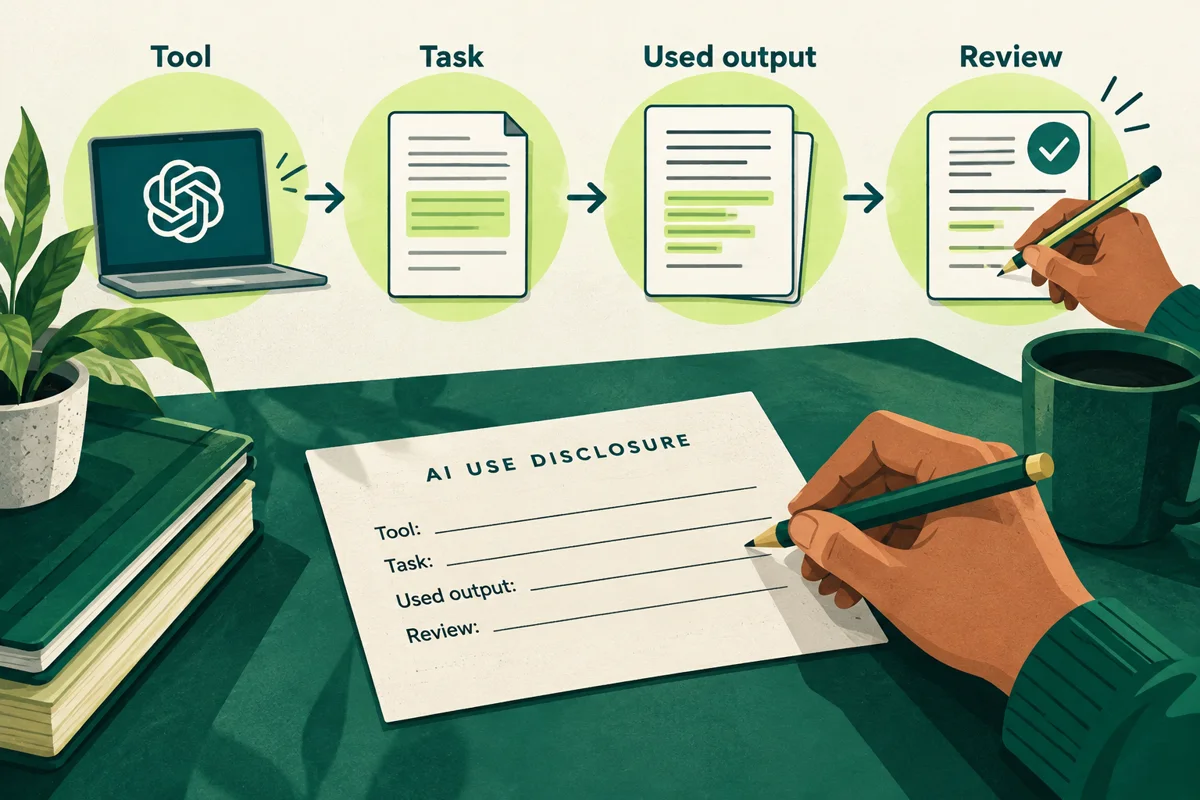
A short AI-use disclosure you can adapt
An AI-use disclosure explains which tool helped with your assignment and what you did with its output. Before using one, check that the assistance itself was allowed. Newman University's student guide says not to assume AI is permitted and to ask the instructor when the rules are unclear (Newman University: Student AI Disclosures).
For a starting point, complete this statement using your own record:
I used [tool and model/version, if known] on [date or date range] to [specific task] for [part of this assignment]. I used the output to [what you actually kept, changed or rejected]. I checked [the specific material you checked]. [Add the record or appendix location if required.]
This and the examples below are original drafting aids, not university-approved forms or reports of real students' work. Delete claims you cannot support. Do not say you verified facts, wrote a section yourself or saved a complete chat unless that is true. Use your instructor's form when one is provided.
Preparing a journal submission rather than coursework? Use our research-paper AI disclosure guide, which covers journal instructions and separates manuscript editing from research use.
Permission, disclosure and citation answer different questions
A disclosure is an account of your process. It does not grant permission to use AI, and it may not replace a citation. The University of Idaho Library distinguishes acknowledging outside content through citations from explaining how a piece of work was made through disclosure (University of Idaho: Citing and Disclosing AI).
Scroll the table to compare all columns.
| Question | What to check | What your statement cannot establish |
|---|---|---|
| Was this assistance allowed? | The assignment instructions and the instructor's clarification | That prohibited assistance becomes acceptable after disclosure |
| How did I use the tool? | Your actual tasks, inputs, outputs and revisions | That every AI-assisted task was only proofreading |
| Do I also need a citation? | The required style and assignment rules for incorporated content | That naming a tool once covers every source obligation |
You may see the term AID statement. Kari Weaver's Artificial Intelligence Disclosure framework organizes disclosure by the roles AI played, such as conceptualization, editing or translation. It is a way to describe the process, not a rule adopted by every college (Weaver: The AID Framework).
Examples for different kinds of AI assistance
Choose the example closest to what happened, then make it specific. If a tool did more than one task, describe the additional work rather than choosing the least substantial label.
Brainstorming and outlining
I used [tool] on [date] to suggest questions about [topic]. I selected [question or direction] and used [specific suggestion] when planning [section]. I developed the submitted analysis using [my notes, readings or other actual sources].
If you adopted an AI-generated outline, say so. If you discarded all suggestions, describe that instead. Brainstorming and adopting a tool's structure are different uses; this wording is a prompt to record which occurred.
Proofreading your own draft
I used [tool] on [date] to identify [grammar, spelling or punctuation] issues in [specified sections]. I accepted [the changes you accepted] and rejected [changes you rejected, if relevant]. The tool also [describe any additional task, or remove this sentence].
Do not call a rewrite proofreading. If the tool produced replacement sentences, altered the structure or supplied ideas, include that contribution. The University of Melbourne lists proofreading and editing among uses to declare in its guidance for students whose coordinator has authorized AI assistance (Melbourne: Acknowledging AI tools).
Rewriting, humanizing or translating a passage
I used [tool] on [date] to [rewrite or translate] [identified passages]. I incorporated [which output or changes] after [describe your actual review]. I retained or corrected [specific terminology, claims or citations, if applicable].
Describe the action, including when a product calls it humanizing. Do not replace a record of AI rewriting with a claim that you only checked grammar. A second round of editing is another step to record, not a reason to omit the earlier assistance. For reviewing a changed passage, use the meaning-preservation checklist alongside your original notes.
Generated text, code or images
I used [tool and version, if known] on [date] to generate [paragraphs, a code function, a figure or other output] for [identified part of the assignment]. I included [what appears in the submission] and changed [what you changed]. I checked it by [specific checks actually completed]. The relevant prompts and output are [location, if required and available].
Name the affected material so the reader can locate it. For code, describe tests you actually ran; for an image, identify the figure; for text, identify the section and any required citations. Newman asks students to explain the task, prompts and use of the output—not just name the product (Newman University: acknowledgement guidance).
More than one tool
I used [tool A] for [task and affected section] on [date], and [tool B] for [different task and affected section] on [date]. I incorporated [describe each tool's contribution] and completed [the review you actually performed]. Records are [location, if required and available].
Keep the contributions separate. A compact table with one row per tool can be clearer than a single sentence saying that several tools helped. Include an AI rewriting tool if it was one of those tools; do not list only the last product used.
Keep a record that supports the statement
The University of San Francisco Library notes that some assignments or publications may ask for prompts or screenshots, and advises checking the applicable requirements. Its guidance also covers assistance beyond quoted text, including analysis and visuals (USF Library: AI Disclosure Statements).
Our practical suggestion is to keep a small log as you work:
Scroll the table to compare all columns.
| Record | What to write down |
|---|---|
| Tool and timing | Product, visible model/version if known, and dates used |
| Task and scope | The question asked, material supplied and affected section |
| Use of output | What you retained, changed or rejected |
| Your review | Sources checked, calculations repeated or code tests performed |
| Supporting files | The permitted location of relevant drafts, prompts and outputs |
If the model or version was not shown, record that rather than guessing. Keep relevant records privately; ask your instructor how to submit them if needed. Do not make a chat public by default or include another person's private information just to create a share link.
Build the statement from your record
- 1 · ToolIdentify the assistance
Use the real tool name and dates; do not guess an unknown model.
- 2 · ScopeLocate its role
Name the task and the specific part of the assignment.
- 3 · ContributionExplain what stayed
Describe output you kept, changed or rejected.
- 4 · ReviewRecord your checks
List the verification you actually completed.
Where should the disclosure go?
Follow the assignment's placement instructions. Melbourne generally places a declaration after the reference list and before appendices; Newman suggests an appendix or the location designated by the instructor. These are examples of local guidance, not one universal format (Melbourne declaration guidance; Newman student guidance).
If nothing is specified, ask: "Where should I put my AI-use statement, and do you need the prompts or outputs?" Do not assume a statement belongs in the bibliography merely because it discusses a tool.
Common questions
Do I need a statement if I did not use AI?
Only make a no-use declaration if it is accurate. Some assignments may ask for one: Melbourne explicitly discusses that possibility. Ask what the declaration covers if built-in writing or translation assistance makes you uncertain (Melbourne: declaration FAQs).
Is "AI was used to improve this assignment" enough?
It leaves the tool, affected material and actual contribution unclear. Idaho's guide identifies the tool, how it was used and what happened to the output as the core elements. Start there, then add the details your instructor requests (Idaho disclosure guidance).
Does the statement replace my references?
Do not assume so. Explaining a tool's role and attributing the ideas, quotations or other material incorporated into the work serve different purposes. Use the required style in our APA, MLA and Chicago citation guide, then verify references against the sources you read. The citation-preservation checklist can help you review those references (Idaho: citations versus disclosure).
Before submitting
- Confirm that the described assistance matches what the assignment allowed.
- Replace every placeholder with a true detail, or remove the optional detail.
- Name the affected parts and distinguish suggestions from generated or rewritten material.
- Describe checks you completed, not checks you intended to do.
- Add required citations, records and the declaration in the requested location.
- If a requirement is unclear, ask the instructor rather than guessing.
The useful statement is the one that lets a reader understand your actual process. It does not need to sound formal at the expense of being specific.
Sources
Primary guidance checked 25 October 2026. Each institution's page describes its own context; these examples do not establish a common rule for every college.
- Newman University Library: Student AI Disclosures — instructor permission, prompts, tasks, output use and placement.
- University of Idaho Library: Citing and Disclosing AI — citation/disclosure distinction and three core details.
- University of Melbourne: Acknowledging AI tools and technologies — locally applicable declarations, authorized assistance and practical FAQs.
- University of San Francisco Library: AI Disclosure Statements — scope of disclosure and varying record requirements.
- Kari D. Weaver: The Artificial Intelligence Disclosure Framework — a role-based approach to describing AI assistance; C&RL News, 2024.