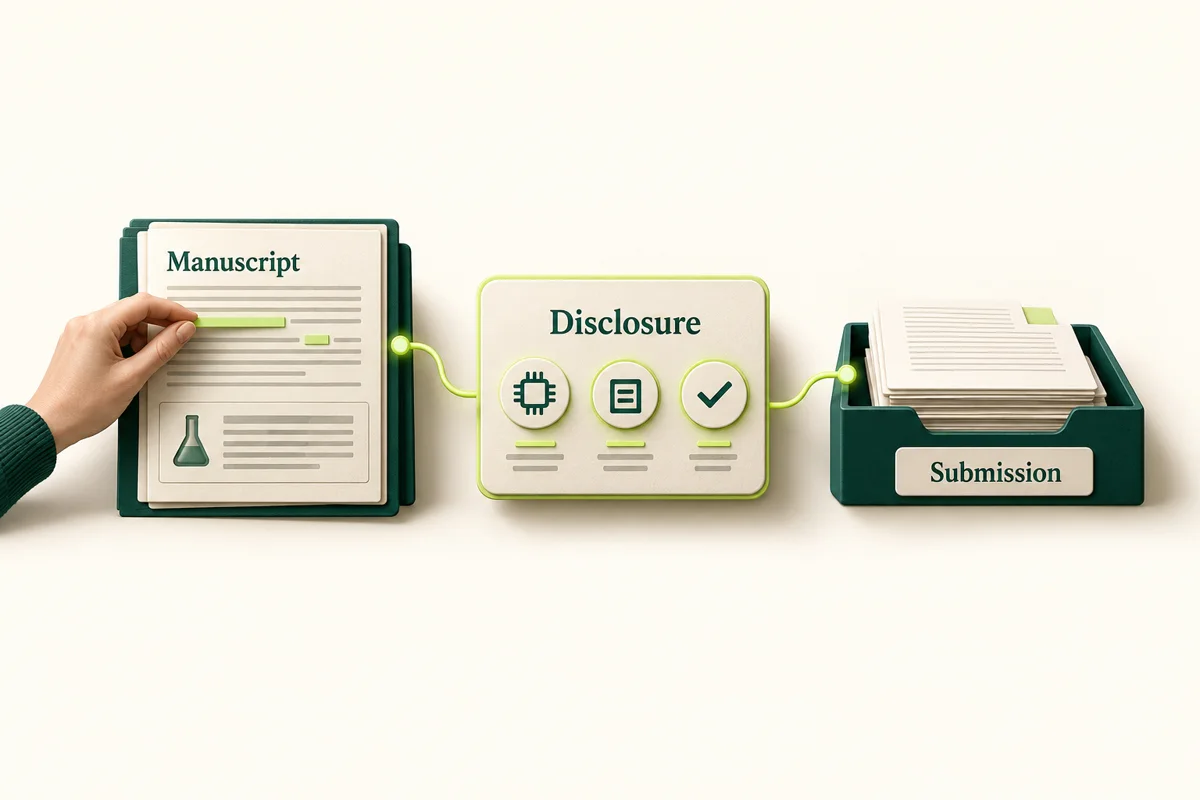
Start with the journal, then describe the actual use
An AI disclosure for a research paper should identify what tool you used, what it did and how you reviewed the work. Before drafting it, read the target journal's current author instructions, AI policy and submission questions. Keep manuscript editing separate from AI used in the research itself.
There is no single statement or placement that fits every journal. Elsevier's policy, for example, separates manuscript preparation from research use and gives different reporting instructions for them. ICMJE's recommendations describe disclosure at submission in the cover letter and the appropriate part of the work where applicable (Elsevier: generative AI policies for journals; ICMJE: use of AI by authors).
This guide concerns authors preparing a journal manuscript. For coursework, use our separate college-assignment disclosure examples. Neither guide grants permission for a use that the relevant rules prohibit.
From actual use to a journal-specific statement
- 1 · PolicyRead the target instructions
Check permitted tasks, exemptions and required locations.
- 2 · RecordDescribe what happened
Identify the tool, task, scope and retained output.
- 3 · ReviewVerify the human checks
State only the checks and limitations you can support.
- 4 · SubmitComplete every location
Align manuscript, Methods, cover letter and forms as required.
Separate proofreading, rewriting and research use
Do not label every form of assistance “proofreading.” Describe the action before deciding which policy provision applies. Our original task sheet helps you gather that description; it is not a list of universally permitted uses.
Scroll the table to compare all columns.
| Actual task | Record before writing the statement | Question for the target journal |
|---|---|---|
| Spelling, punctuation or basic grammar checks | The feature and what it changed | Does the policy exempt this specific basic check? |
| Sentence or paragraph restructuring | Sections affected, proposed wording and changes retained | Is this substantive AI editing that needs a declaration? |
| Translation of an author's draft | Languages, scope, output retained and who checked it | What translation permission, review and disclosure are required? |
| Generating text or literature suggestions | What was generated, verified, rejected or incorporated | Is the use permitted, and where must it be described? |
| Analysis, code or another research task | Tool/version, task, settings and validation actually performed | What Methods or reproducibility reporting is needed in addition to a writing disclosure? |
For example, Elsevier exempts basic grammar, spelling and punctuation checks from a declaration but says substantive changes to sentence structure or organisation should be disclosed. Its policy directs research-process use to the Methods section. That boundary is more specific than whether an app markets itself as an editor (Elsevier: disclosure and research use).
Compare the instructions without treating them as interchangeable
The following readings were checked on 30 October 2026. They are a starting point for checking the exact journal, not a complete policy survey or a prediction that a submission will be accepted.
Scroll the table to compare all columns.
| Source and scope | What the cited guidance asks for | Placement or boundary to check |
|---|---|---|
| Elsevier: journal policy | Tool name, purpose and human oversight for manuscript preparation | A separate declaration immediately before references; research use belongs in Methods; basic-check exemption has limits |
| ICMJE: author recommendations | Explain whether and how AI-assisted technologies were used in submitted work | Cover letter and the appropriate section of the submitted work where applicable; check the medical journal's implementation |
| Taylor & Francis: AI policy | An article statement naming the tool and version, how it was used and why | Check the journal's specific instructions and required submission fields rather than importing another publisher's placement |
These sources keep responsibility with human authors. ICMJE says AI tools should not be listed as authors because they cannot meet the required responsibilities, and authors must review AI-assisted content and ensure appropriate attribution (ICMJE: responsibility and authorship).
Build a record before polishing the wording
A vague sentence such as “AI was used to improve this paper” gives you little to check. Assemble the facts first. The following record sheet is our practical editorial aid; complete only what you can support.
- Target policy: journal name, policy link, check date and any editor clarification.
- Tool details: service, model/version where available, feature used and dates. If a required version is unknown, investigate or ask the journal how to report it; do not invent one.
- Task and scope: language revision, translation, coding or another actual task, with the affected sections or workflow.
- Input and output: the starting material, retained output and important changes or rejected suggestions.
- Human review: the checks actually performed, who performed them and any limitations.
- Locations to complete: manuscript statement, Methods, cover letter, submission form or another journal-required location.
Retain permitted records in appropriate storage and avoid sharing confidential material merely to demonstrate tool use. Taylor & Francis asks authors to check that their chosen tool's terms provide appropriate confidentiality, security and intellectual-property safeguards (Taylor & Francis: responsible use and tool suitability).
Adaptable wording for language editing
Use the journal's own form when one is supplied. This is original drafting support, not an approved publisher statement or a report of a real manuscript:
For language revision of [specific sections], we used [tool, model/version and feature] to [exact editing task] during [dates]. We retained [describe the scope of the changes] and checked them against [the original claims, terminology, citations or other material actually reviewed]. [Identify any additional generated content and its treatment, if applicable.] The authors remain responsible for the submitted text.
Replace every placeholder and remove claims you cannot substantiate. Do not say “no new content was generated” merely because you intended to request proofreading; check what the tool actually produced and what entered the manuscript. Likewise, do not say all references were verified if that check was incomplete.
For a narrow hypothetical example, an author who only accepted wording suggestions in an introduction would identify that section and those changes. An author who also asked for a new discussion paragraph has another task to report and a permission question to resolve. Calling both workflows “language correction” would obscure that difference.
If AI was part of the research, report more than an editing statement
A language-editing paragraph does not describe an analysis workflow. Where reporting is required, document the actual task, tool/version, inputs, settings, outputs used and validation so a reader can understand the method. Elsevier distinguishes research-process use from manuscript preparation; follow the discipline's and journal's specific reporting requirements (Elsevier: research-process reporting).
Our starting outline for gathering that information is:
In [research task or workflow stage], [tool and version] was used to [specific operation] with [relevant inputs and settings]. The resulting [output] was handled by [actual review, validation and subsequent processing]. [State the location of permitted supporting records and any material limitations.]
This outline does not establish reproducibility, validate an analysis or replace a field-specific reporting standard. Do not fill it with plausible-sounding settings or checks that you did not record. If tool use affected scientific decisions rather than just presentation, discuss the reporting with the responsible co-authors and journal.
Check the manuscript and the submission together
Before submission, compare your statement with the version you are actually submitting. If a co-author used another tool or a later revision changed the scope, update the record and the relevant statements. Our final review checklist is:
- Does the statement describe every relevant task, not just the first editing pass?
- Are the tool/version details supported by your records?
- Are basic checks distinguished from substantive rewriting or research use?
- Have you completed every location the journal requires?
- Can the named human authors stand behind the checks described?
- Have quotations, references and scientific claims been reviewed against the underlying sources?
- Does the statement avoid promising more review than was performed?
For checking references, use our citation-verification workflow. For comparing revised language with the original claim, see revising without changing meaning.
Where a writing tool fits
If your journal and applicable research rules permit the proposed revision, you may choose HumanWords as part of that workflow. Describe the actual assistance and check retained changes yourself. Do not assume a “humanizer” automatically qualifies for a basic-proofreading exemption or that disclosure guarantees acceptance.
This article addresses text preparation and reporting. Figures, research images, data generation and peer review have separate policy questions; check their applicable instructions before using tools for those tasks. We did not test a journal submission, assess a real manuscript or establish that any particular product use meets a publisher's requirements.
Sources and scope
- Elsevier: Generative AI policies for journals. Current author disclosure, basic-check boundaries, placement and research-use instructions; checked 30 October 2026.
- ICMJE: Use of AI by Authors. Author recommendations on submission disclosure, responsibility, attribution and authorship; checked 30 October 2026. These are medical-journal recommendations, not a universal rule for every publication.
- Taylor & Francis: AI Policy. Article disclosure content and responsible tool choice; checked 30 October 2026. Book-specific approval instructions are outside this guide's article-submission scope.
The task sheet, record list, wording outlines and hypothetical examples are original HumanWords editorial aids. They are not journal-approved forms, evidence of acceptance, or reports of actual tests. Check the live target-journal instructions again before submitting; policies and submission forms can change. Exact keyword volume is unknown.