Start with the rules for your assignment
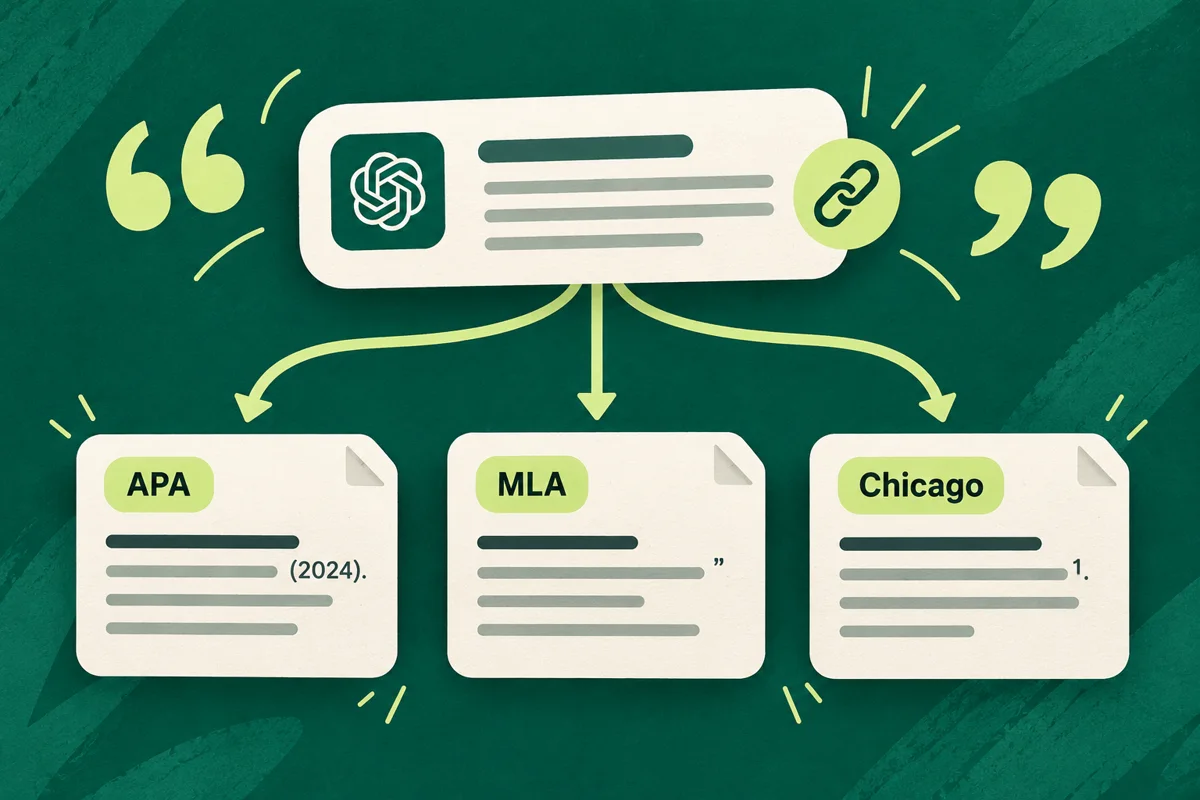
APA, MLA, and Chicago give different ways to identify an AI-generated response. Your instructor, department, publisher, or workplace may also set its own rules for whether AI is permitted and what use must be disclosed. A citation identifies a source or tool; it does not by itself explain how you used AI or show that your use was allowed. APA and MLA both distinguish citation from broader disclosure, so check the policy for the work you are submitting (APA Style’s guidance on citing generative AI; MLA’s guidance on describing AI use).
For a separate account of the tools and tasks involved, use our AI-use disclosure examples. These examples are templates. Replace each bracketed item with details from your actual chat or tool. Do not invent a model name, date, title, or share link.
From AI assistance to a clear record
- 1 · PermissionCheck the rules
Confirm what AI help your assignment allows.
- 2 · RecordSave the details
Keep the tool, model, date and relevant conversation.
- 3 · FormatChoose the style
Follow the APA, MLA or Chicago guidance below.
- 4 · VerifyRead the sources
Check the facts and references behind the answer.
APA Style
APA’s current guidance distinguishes between citing a specific chat and citing an AI tool generally. Cite a particular chat when readers would benefit from seeing the exact conversation; for some uses, such as editing your own writing, APA says a general tool reference and a description of the use may be more appropriate than listing every chat (APA Style: reference formats for generative AI).
For a specific ChatGPT conversation, APA’s format is:
OpenAI. ([Year, Month Day]). [Title of chat] [Generative AI chat]. ChatGPT [model name, if known]. [Shareable chat URL]
The in-text citation uses the company and year: (OpenAI, Year) or OpenAI (Year). Use the conversation date, a descriptive chat title, and a shareable URL if the chat has one. If you are citing ChatGPT as a tool rather than a particular conversation, APA’s general software format is:
OpenAI. ([Year of tool update]). ChatGPT [Large language model]. https://chatgpt.com/
For the year in a general tool reference, use the latest update year that APA’s guidance calls for, rather than assuming it is the current calendar year. If you used an AI-powered search to find sources, APA says to read and cite the sources themselves—not the AI summary as a substitute (APA Style: AI in search and common software).
MLA Style
MLA does not recommend treating the AI tool as the author. Its current template starts with a short description of what the tool generated, then names the tool, model, company, date, and location. MLA prefers a stable, shareable conversation URL; if the tool does not provide one, its general URL may be used (MLA Style Center: citing generative AI).
“[Brief description of the generated response]” prompt. ChatGPT, model [model name or version], OpenAI, [day month year], [shareable chat URL].
MLA’s examples use a brief prompt description in the in-text reference to connect the passage to the Works Cited entry. Follow the pattern and any additional instructions from your teacher or editor. If your use went beyond quoting or paraphrasing generated output—for example, AI played a substantive role in drafting—MLA says to acknowledge that use separately when appropriate; a citation alone may not fully describe it (MLA Style Center: describing AI use).
Chicago Style
Chicago’s public Q&A says that in many kinds of writing, you can name the AI tool in the text. For a formal student paper or research article, it gives a numbered footnote or endnote format (Chicago Manual of Style Q&A: citing AI-generated content).
- ChatGPT, response to “[prompt or short description],” OpenAI, [Month Day, Year], [shareable URL].
If the generated text was edited, Chicago advises saying so in the text or at the end of the note. Use the citation system assigned for your paper, and ask whether your instructor also wants a bibliography entry or a separate disclosure.
Cite the sources behind an AI answer
If ChatGPT points you to an article, book, dataset, or other source, open and read that source yourself. Cite the original material you actually used, not an AI-generated summary as though it were the original source. APA and MLA both warn that AI tools can omit context, misstate sources, or provide references that need checking (APA Style’s guidance on AI as a search tool; MLA Style Center’s guidance on describing AI use).
Before you submit
- Check the assignment’s AI-use and disclosure policy; citation format does not grant permission to use AI.
- Record which tool and model you used, the date, and whether you are citing a particular response or general tool use.
- Use a shareable conversation URL only if it is appropriate to share that conversation.
- Verify facts and references against sources you read directly.
- Keep the original draft and notes if you need to explain how the work developed.
For guidance on preserving source attributions while revising, see HumanWords’ citation checklist for rewriting. For a broader explanation of detector scores and their limits, read the AI detection score guide.
Sources
- APA Style: Citing generative AI in APA Style, Part 1—Reference formats
- APA Style: Citing generative AI in APA Style, Part 2—AI as a search engine and AI integrated into common software
- MLA Style Center: How do I cite generative AI in MLA style?
- MLA Style Center: Beyond Citation—Describing AI Use in Your Work
- The Chicago Manual of Style Q&A: How do you recommend citing content developed or generated by artificial intelligence?