GPTZero alternatives: start with the job you need done
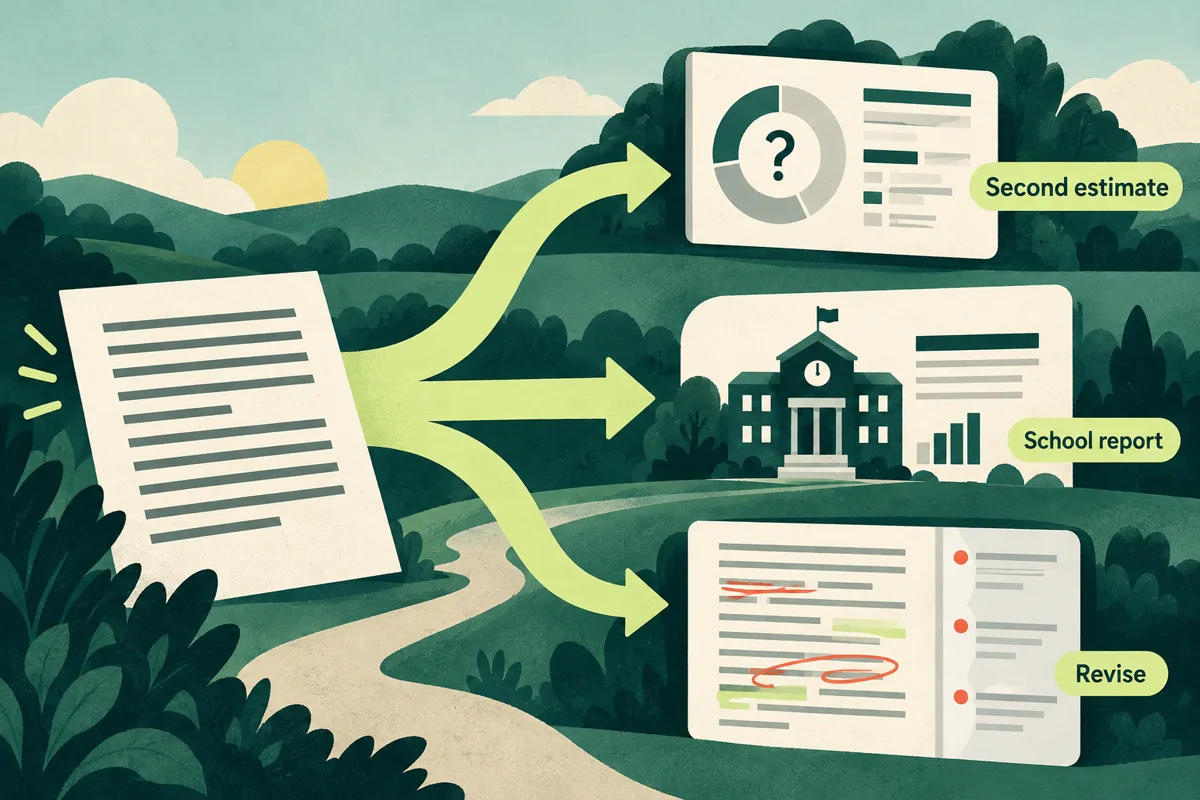
A useful GPTZero alternative depends on the job: another AI-writing estimate, the report your school uses, or help reviewing a draft's wording. Those are different requirements. Start with your task, text and access needs before comparing product names or paying for a plan.
An AI-writing estimate is not a record of who wrote a document. GPTZero cautions that no detector is completely accurate, and Turnitin warns that its model can misidentify text and should not be the sole basis for adverse action (GPTZero: technology overview; Turnitin: AI Writing Report).
Compare the alternatives on the same requirements
The readings below were checked on 1 November 2026. Product pages and API documentation are different evidence: an API feature is not a promise about every consumer account or plan. Where a cited page does not settle access or quotas for your intended product, verify them before relying on it.
Scroll the table to compare all columns.
| Tool or route | Relevant published information | What to verify for your task |
|---|---|---|
| GPTZero, the baseline | Describes document classifications, confidence categories and sentence-level insights | Which product interface and plan exposes the report you need; what each displayed measure means |
| Sapling web detector | States that a free check covers the first 2,000 characters; Pro supports up to 100,000 characters per check | How much of your actual document will be scored, and whether an upgrade is needed |
| Copyleaks AI Text Detection API | Documents detection support for 30 languages, with a narrower language set for optional AI Logic explanations | Whether you need API access or a consumer interface, and whether the specific explanation feature supports your language |
| Turnitin AI Writing Report | Lists 300–30,000-word file requirements and defines its result over qualifying long-form prose | Institutional availability, eligible text and report access; a different checker is not the institution's report |
| HumanWords | Combines an AI-writing estimate with a separate rewrite you can review | Current allowance and plan details, permission to use assistance, and the accuracy of any changes you retain |
This is a fit comparison, not a performance ranking. A longer input cap, more languages or a more detailed-looking report does not by itself establish better detection accuracy.
Check coverage before reading the score
Check the unit beside a limit. Characters and words are not interchangeable. Sapling's current free notice says it checks the first 2,000 characters, and its upload field asks for selectable text; scanned images need OCR first. Its page also distinguishes Pro from separately billed API use (Sapling: current checker limits and input).
For an invented planning example, suppose your document contains 12,000 characters. A first-2,000-character check covers only one-sixth of that input, not the whole draft. This is simple arithmetic applied to an illustrative length, not a live scan or a claim about detection quality. Record the text actually checked rather than presenting the result as an assessment of everything in the file.
Turnitin's requirements are different: its report concerns qualifying prose in a long-form submission. A file's total word count and the portion eligible for a particular report are therefore separate things to inspect (Turnitin: qualifying text and file requirements). Do not assume a table, bullet list or very short passage is treated like an essay.
For a quota-focused comparison of additional providers, see our free AI detector access guide. It owns free-offer details; this guide focuses on choosing a workflow.
Separate language support from report features
Ask two questions: can this product process the language, and does it provide the feature you need in that language? The answers can differ even within one service.
Copyleaks' API documentation lists 30 detection languages, but its optional AI Logic explanations are listed for English, Spanish, French, Portuguese, German and Italian. The documentation says detection can still run for other supported languages without those explanations. These are API statements; check the actual product and plan you intend to use (Copyleaks: detection and explanation languages).
Sapling's web page currently lists English, Spanish, Portuguese, French, German, Italian, Dutch and Japanese, with automatic language detection. Availability is a provider claim, not evidence of equal performance across languages (Sapling: supported languages).
Record the language, interface and feature together. “Supports my language” is not enough if your task specifically needs a sentence explanation, file upload or another report feature.
Choose a workflow that fits your task
Use this decision sheet before opening several tools. The scenarios are original planning examples, not reports of real students or test results.
Scroll the table to compare all columns.
| Your actual need | A sensible next step | What the result will not establish |
|---|---|---|
| Another estimate for a passage | Shortlist tools whose input and language requirements fit; compare the same permitted, non-sensitive text | That a second score identifies the author or resolves every disagreement |
| The report attached to a school submission | Ask which institutional report is enabled and how you can review it | That an unrelated consumer score reproduces the school's result |
| A language or explanation feature | Check the precise product documentation and account access | That an API language list guarantees all features in every plan |
| Changes to wording | Keep the original, confirm assistance is permitted and inspect retained changes | That fluency or a lower detector score preserves the argument |
Keep reporting and revision separate. If you need to explain an institutional result, use the institution's process. If you are revising a draft, review the actual claims, evidence and attribution. Neither task is completed by collecting more percentages.
Start with the job you need done.
- Another writing estimateCompare detectors
Check what each score means, the input limits and supported languages.
- A school submission reportAsk your institution
Confirm which report is enabled and whether you can view it.
- Changes to your wordingReview a rewrite
Keep the original and check meaning, citations and attribution.
Make a comparison record you can interpret later
Before making a comparison, confirm that you are allowed to share the material with the services involved. Use only suitable non-sensitive material; keep private, restricted or customer writing out of casual product tests. This guide required no writing submission to another tool.
Our original comparison log records the conditions rather than inventing scores:
Scroll the table to compare all columns.
| Record | Why it matters |
|---|---|
| Purpose and permission | Makes clear what question you are checking and what material you may share |
| Exact input and language | Prevents differences in the passage from being mistaken for tool differences |
| Length and covered portion | Shows whether a limit or truncation changed the actual input |
| Product, interface, plan and date | Distinguishes a web checker, API and institutional report |
| Measure and explanation | Separates a classification, confidence category and flagged-text share |
| Outcome and next review step | Captures what you observed without treating it as a verdict |
GPTZero's documentation, for example, distinguishes document classifications from confidence categories. Turnitin defines its percentage over qualifying text and separates it from the similarity score (GPTZero: report measures; Turnitin: report interpretation). Do not average different measures or treat them as interchangeable probabilities.
A matched-input comparison shows how tools responded to that sample. It does not establish which detector is more accurate overall. That stronger claim needs a documented evaluation with known human/AI labels and checks for both false positives and missed AI text. We performed no such test here.
Ask privacy and access questions before uploading
A convenient upload box does not answer what happens to the writing. Before choosing a service, check the applicable terms and privacy policy for:
- what text or files are stored, for how long and under which account settings;
- whether content may be reused, shared or used for training;
- what deletion or retention controls actually apply;
- whether a shareable report exposes the passage to other people;
- what an account, subscription or API purchase includes, and how cancellation works;
- any school, employer or research restrictions on the material.
These are due-diligence questions, not findings that every provider follows the same practices. A privacy statement, account setting and independently verified privacy guarantee are different kinds of evidence. Our essay-upload privacy guide explains the checks; read the current HumanWords Privacy Policy for our practices.
What to do after the review
If a result concerns you, review the underlying writing and the context rather than rewriting solely to change the number. Keep source notes, earlier drafts and relevant records. Our draft/version-history guide offers a practical way to retain them, without treating history as proof of authorship.
If your task permits revision and you choose HumanWords, compare its separate rewrite with the original and check meaning, facts and citations yourself. See current plans before relying on an allowance, and use our AI detection score guide for interpreting estimates. No tool in this table grants permission for otherwise prohibited assistance.
Sources and scope
- GPTZero: technology overview. Provider-stated classifications, confidence/report features and limitations; rechecked 1 November 2026. Marketing accuracy figures were not adopted as independent results.
- Sapling: AI detector. Current web cap, Pro cap, selectable-text input, separate API billing and published language availability; rechecked 1 November 2026. No trial started or output tested.
- Copyleaks: AI Detection Supported Languages. API detection languages and optional explanation-language limits; rechecked 1 November 2026. Consumer-plan equivalence is not claimed.
- Turnitin: Using the AI Writing Report. File/qualifying-text requirements, score interpretation and human-review cautions; rechecked 1 November 2026. Institutional access is not established by this public page.
- HumanWords: homepage, plans and privacy policy. First-party workflow and current details; checked 1 November 2026.